• HOME
  • ABOUT
  • FREE VIDEO TRAINING
  • LOUISE ON THE BEET
  • SERVICES
Menu

Louise Carr

Street Address
City, State, Zip
Phone Number
Holistic Nutrition Counselling

Your Custom Text Here

Louise Carr

  • HOME
  • ABOUT
  • FREE VIDEO TRAINING
  • LOUISE ON THE BEET
  • SERVICES
Louise_Banner.jpg

Recipes and Posts

Can food really relieve menopause symptoms naturally?...Yes. And the evidence is overwhelming!

March 16, 2026 Louise Carr

If you're in perimenopause or menopause and living with hot flashes, night sweats, weight gain, brain fog, broken sleep, or low mood, what you eat every single day is the most powerful lever you have to change the way you feel.

More powerful than most women realize.

More powerful than most doctors will ever tell you.

I know this because food changed everything for me.

When I hit perimenopause, my doctor offered no diagnosis, no guidance, and never once said the word menopause. His advice for my depression, 3am wake-ups, anxiety, aching joints, and weight gain I couldn't shift?

"Eat less and exercise more."

So I enrolled in the Canadian School of Natural Nutrition and spent a year learning how to nourish my midlife body. I reversed every single symptom, without HRT, without medication, without a prescription. That was 2015 and the research has only grown stronger since.

What does the science say about nutrition and menopause?

1. Phytoestrogens reduce hot flashes and protect bone density

Phytoestrogens are plant compounds that interact with estrogen receptors in the body. Research published in the Journal of Nutrition (2024) confirms that regular consumption of phytoestrogen-rich foods reduces hot flash frequency and increases Bone Mineral Density in postmenopausal women consistently, across multiple study designs.

2. The estrobalome: your gut microbiome manages your oestrogen

Researchers have identified the estrobalome. Gut bacteria responsible for metabolising estrogen. A compromised microbiome means estrogen is processed poorly, directly worsening bloating, hot flashes, and mood instability. Eating for gut health is eating for hormone balance.

3. What you eat now protects your brain for decades

Research led by Dr Lisa Mosconi confirms the midlife brain undergoes significant changes during the menopause transition. The nutritional choices you make in your 40s and 50s directly influence your long-term cognitive resilience and dementia risk.

4. Even the humble prunes prevents bone loss a 2022 Study explained

A randomized controlled trial found that 50g of prunes daily,roughly five to six prunes, prevented loss of total hip bone mineral density in postmenopausal women over 12 months. Prunes provide a simple, accessible, extraordinary source of boron and vitamin K for your body to work with.

So, what should women eat during menopause?

The most evidence-backed approach includes:

  • Phytoestrogen-rich foods: flaxseed, soy, legumes, sesame

  • Prebiotic and probiotic foods to support the estrobalome

  • Anti-inflammatory whole foods for joint pain and brain fog

  • Calcium and Vitamin D-rich foods for bone density

  • Blood sugar-balancing meals to reduce hot flash triggers and support deep sleep

The challenge is the overwhelm of trying to eat ALL the right things!
It's knowing how to make it practical, delicious, and sustainable when you're already over-stretched and holding everything together in your world.

That's exactly what Menopause U solves.

Menopause U is my online nutrition course built specifically for women in their 40s and 50s. It translates the latest menopause nutrition research into short, clear videos — and pairs every concept with easy, family-friendly recipes that do the work for you.

No overwhelm. No diet culture. No "eat less and exercise more."

Just food that works for your midlife body, starting today.

Learn More about Menopause U HERE

And watch this space because I will be in my kitchen creating delicious and easy recipes with prunes to share on this blog!

In Nutrition Tips
Comment

Grounding Chicken, Apple and Lentil Casserole

January 16, 2026 Louise Carr
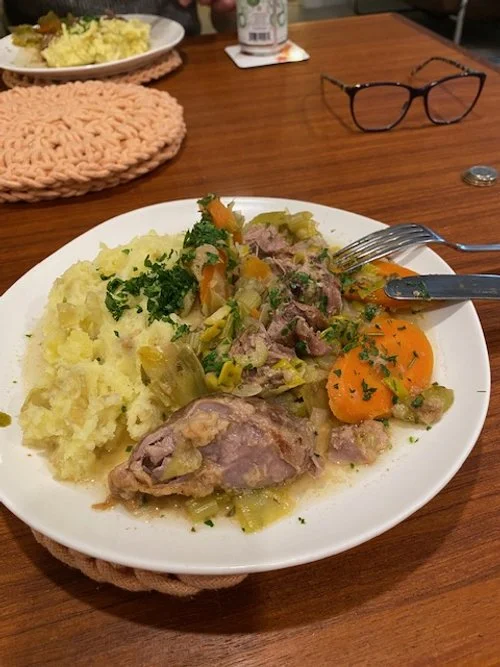
Chicken, Lentil and Apple Casserole

This week has been intentionally quiet for me prompted by the chaotic news cycle.

I’ve been staying off social media for a couple of hours at the beginning and end of my day, returning to my meditation practice, getting back into the gym to feel physically strong, and walking outside in the sunshine whenever the weather allows.

Nothing fancy. Just a down regulation of violent images, 3 whole meals a day and movement as nervous system care.

One thing you may not know about me is that I spent 25 years in a marriage characterized by covert narcissistic abuse.

I left this relationship in 2017, and since then I’ve been in therapy becoming more empowered to protect and care for myself and healing from complex-PTSD and co-dependency.

Because of this history, I am fiercely protective of my brain and heart health.

After a lifetime of chronic stress from living with anger and verbal abuse, I know my early warning signs:

  • My sleep starts to deteriorate and I am tossing and turning in a hot sweat

  • I wake at 3am with a pounding heart and anxious ruminating thoughts

  • Daily brain fog creeps in and focus, creativity and motivation disappear

And I want to be very clear about something important.

These symptoms are labelled as being caused by declining hormones, BUT this is stress.

Midlife is a season where your body becomes far less tolerant of overload.

When stress rises and we don’t put boundaries in place, your hormones pay the price. Chronic stress is a hormone stealer, draining estrogen, progesterone and testosterone to build our stress hormone cortisol.

If you’re in your 40s or 50s and you keep pushing through without protecting your peace, the eventual outcome is often a full crash to zero. And then we’re left wondering why everything feels so hard.

Your symptoms are not your body failing you or your hormones waging war against you.
They are information; and a powerful call to action to put boundaries around your schedule, screens and sleep.

Food can be a powerful part of stress support too.

  • Balanced blood sugar helps reduce anxiety and calm your brain with a steady supply of glucose.

  • Fibre and healthy fats help you to feel satiated and protect your mood and brain by supporting your microbiome.

  • Iron and B-vitamin rich foods support mood, focus, and nervous system resilience.

That’s why deeply nourishing, grounding meals matter so much right now, like the Chicken, Apple & Lentil Casserole I’ve shared below. This is the kind of comfort food that tells your body: you are safe, you are supported, you can exhale.

Ingredients

4 boneless chicken breasts with skin on

3 tbsp extra virgin olive oil

25g/1oz organic butter

1 large onion, finely chopped

2 large carrots, sliced

2 celery stalks, trimmed and sliced

½ tsp finely chopped fresh thyme

175ml/6fl oz chicken broth

175ml/6fl oz apple juice

¼ cup red lentils

1 large or 2 smaller apples peeled, sliced

salt and freshly ground black pepper

Instructions

  1. Preheat a deep, lidded pan or casserole for 2 minutes over a moderately high heat.

  2. Add one tablespoon of oil when hot, add half the butter.

  3. Place chicken breasts in the pan, skin-side down and fry for 2-3 minutes, or until the skin is nicely browned and golden

  4. Turn the breasts over, turn the heat down and fry the other side for 1-2 minutes. Remove the chicken breasts to a plate, discard the fat in the pan and wipe it clean.

  5. Return the pan to a moderate heat and add the remaining oil and butter.

  6. Add the onion, carrot and celery, stir well, cover the pan and cook for five minutes, or until the vegetables are beginning to soften. Stir in the thyme.

  7. Add chicken stock and apple juice, bring to boil and add apples and red lentils.

  8. Turn heat down and return chicken to the pan, spooning vegetables and apple over top.

  9. Replace lid and simmer for about 35-40 minutes.

  10. Check the seasoning, adding extra salt or pepper to taste.

Are You Really a Victim of Your Hormones in Your 40s — or Is Something Else Going On?

January 5, 2026 Louise Carr

If you spend any time on social media, you’ve probably heard this story about menopause:

That in perimenopause, estrogen just packs her bags and leaves.
That your body suddenly breaks down.
That the symptoms you feel in your 40s and 50s mean your hormones have failed you.
That you’re now at the mercy of your biology.

It’s a compelling narrative.
It’s also unscientific and deeply disempowering for women. It leaves you feeling helpless and stuck!

Let’s talk about what actually happens in perimenopause and menopause, and why so many women feel exhausted, anxious, inflamed, and “not like themselves” in midlife.

Your Body Doesn’t Fail You in Menopause. You are uniquely designed to step into the next chapter of life as a matriarch.

One of the biggest myths about menopause is that hormone production simply stops.

It doesn’t.

When ovulation ends and your egg supply dwindles, your ovaries don’t suddenly shut down and abandon you. Instead, your body adapts by shifting hormone production.

Think of it as a baton pass.

During your reproductive years, your ovaries are the primary producers of estrogen, progesterone, and testosterone. As ovulation ends, that baton is passed to your adrenal glands, which continue to produce these hormones at lower, steadier levels.

This low-level hormone production is not an accident.
It is protective and used as the guide for the prescribing of HRT as it is age appropriate.

It supports your brain, bones, metabolism, muscles, tendons, vagina and heart health during the menopause transition.

You were never designed to fall apart in midlife.
You were designed to evolve.

Menopause Is Not a Design Flaw — It’s a Life Stage

From an evolutionary perspective, menopause is not a failure of the female body.

Humans evolved for women to live decades beyond their reproductive years. This phase of life exists so women can step into leadership, wisdom, and influence what many cultures refer to as the matriarch phase.

The problem is not menopause itself.
The problem is how modern life interacts with this transition.

Why Menopause Symptoms Feel So Intense for Many Women

If your symptoms feel loud, overwhelming, or debilitating in your 40s or 50s, it’s understandable to assume your hormones are to blame.

But often, hormones are not the root cause they and your symptoms are the messengers.

Because your adrenal glands are also responsible for your stress response, menopausal symptoms are frequently amplified by:

  • Chronic stress and a constantly activated nervous system

  • The stress of poor or insufficient sleep

  • Stress related blood sugar instability

  • The body stress of under-eating or yo-yo dieting

  • The fight or flight response triggered by caffeine and the stress of protecting the body from alcohol

  • Poor digestion and nutrient absorption

  • A lifetime of saying yes to everyone else and no to yourself

In other words, many women aren’t broken — they are burned out and under-fuelled.

Your hormones are exquisitely sensitive to stress, nutrition, and recovery. When those systems are strained, symptoms become louder.

You Can Influence Your Hormones at Any Age

This is the part of menopause education that rarely gets enough airtime:

You are not powerless.

Your daily habits directly influence how your body produces, uses, and clears hormones — even in perimenopause and menopause.

Progesterone and Calm

Progesterone supports sleep, mood, and nervous system regulation.
It is strongly influenced by rest, stress reduction, and adequate nutrients like magnesium.

Chronic stress diverts the building blocks needed to make progesterone, which is why anxiety and sleep issues are so common when women are exhausted and over-extended.

Testosterone and Energy

Testosterone supports energy, motivation, muscle mass, confidence, and resilience.
It increases when you lift heavy, challenge your muscles, and allow time for recovery.

Over-training without rest can suppress testosterone just as much as not moving at all.

Estrogen and Vitality

Estrogen supports joint health, brain function, skin, and cardiovascular health.
It can be supported through phytoestrogen-rich foods, adequate healthy fats, and — again — sufficient rest.

Your body also relies on good digestion and liver function to recycle and balance estrogen effectively.

Why “Eat Less and Exercise More” Makes Menopause Worse

Many women enter perimenopause already exhausted from decades of dieting, pushing, and ignoring their own needs.

When symptoms appear, they’re often told to:

  • Cut more calories

  • Exercise harder

  • Drink more caffeine to push through

This advice often backfires.

Under-fueling and over-exercising increase stress hormones, destabilize blood sugar, and further disrupt hormone balance. Instead of relief, symptoms intensify.

Menopause is not the time to shrink yourself.
It is the time to support your biology, to create a new relationship with yur body and with food and to center your health in your life.

You Are Not a Victim of Your Body…And that means you have agency.

Small, sustainable shifts in nutrition, sleep, stress, and movement can dramatically reduce menopausal symptoms over time — without fighting your body or fearing it.

You are not broken.
You are not failing.
You are transitioning into a powerful new phase of life.

A Calmer, More Empowered Midlife Is Possible

Menopause doesn’t require fixing — it requires listening, nourishment, and support.

When women stop blaming their bodies and start working with their biology, everything changes: energy, sleep, mood, confidence, and clarity.

This is what science-based menopause education should look like, grounded, compassionate, and empowering.

If you’re ready to stop seeing yourself as a victim of hormones and start reclaiming your power in midlife, you’re exactly where you need to be.

Make 2026 the Year You Stop Feeling at War With Your Body

If there’s one thing midlife makes painfully clear, it’s this:
There are many things you cannot control right now.

You can’t control aging.
You can’t control past stress or decades of under-fuelling.
You can’t control a healthcare system that often minimizes women’s symptoms.

But there is one powerful area where you still have agency and that is how you nourish your body.

2026 doesn’t have to be another year of feeling like a victim of your hormones, your energy, or your symptoms.
It can be the year you stop outsourcing your power and start working with your biology.

That’s exactly why I created Menopause U — my online, science-based nutrition course for women in perimenopause and menopause who are done blaming their bodies and ready to feel better from the inside out.

Inside Menopause U, you’ll learn:

  • How to eat to stabilize blood sugar, support your nervous system, and reduce symptoms

  • How nutrition directly influences estrogen, progesterone, and testosterone in midlife

  • Why chronic stress and under-fuelling amplify menopause symptoms — and how to reverse that

  • How to make simple, sustainable shifts that actually fit real life

This isn’t about restriction, perfection, or “fixing” yourself.
It’s about reclaiming your agency through nourishment and consistent baby-steps that lay down new healthy habits and a new relationship for you with food and your body.

If you’re ready for 2026 to be the year you stop feeling broken and start feeling grounded, calm, and in control again, Menopause U is where that shift begins.

👉 You can join Menopause U Here!

Older Posts →

Copyright © 2024 Louise Carr Nutrition All rights reserved

Privacy Policy Terms of Use